
The Awakening of a Female Musical Pharaoh
Notes from my diary.......I started
this float.... in February and now I dun' funked
around and March....Women's
History Month has already rolled in and out and now - we are in April.
But.. It's still all good... because
I believe Black History should be 24/365, not just for 30 AND..... as I started
digging around in my creative Pyramid.... I kept finding these fun
archeological finds .... so
voila!
We all may celebrate Black History Month in many different ways but how 'bout celebrating some of
your own Black History..? Or making your own.
Sometimes finding one thread can send
one into a total Sankofa stream of memories...

Poking around the net I found this
article by Neil Tessor of the Chicago Reader that included me... and I was
transported back to a time of many musical and mystical moments...
"Do you remember the
time?".......MJ
This article talked about the time
when I became a female musical Pharaoh. I joined the musical group The Pharaohs for a moment as a keyboardist to play
a series of concerts. We played at the Field Museum, at the Velvet Lounge and for a television performance.
Sir Charles Handy, trumpeter, and
founding member of the Pharaohs named me...Queen Hatshepsut ...because I was
the only female Pharaoh in the group. (as a instrumentalist)

Queen Hatshepsut, Female Pharaoh of Egypt.. of the 18th
Dynasty. Statue of Hatshepsut meaning Foremost of Noble Ladies,(1508 BC - 1458
BC). She was the fifth pharaoh
of the eighteenth
dynasty of Ancient Egypt.
She is generally regarded by Egyptologists
as one of the most successful pharaohs, reigning longer than any other woman of
an indigenous
Egyptian dynasty. Source :
Wikipedia
What an honor... to play music of a
group that I loved in the 70's....

I remember when I first bought the Pharaohs album,
"The Awakening"
I must have played the song, Damballa at least 20 times a day. The music buried deep into the crevices of my spirit.
Who knew at least 3 decades later, that I would be
honored to play the music that had excited me as young spirit...?


In the Basement - The
Pharaohs
As I began to study
African dance, I met conga drummer, Oye Bisi (top left corner) when he played
with the Sun drummers..... I met percussionist, Don Moye (bottom right corner) around the Musicians
building in Hyde Park where all my friends lived... as well as my piano
teacher.

But looking back at my path on my
musical journey...I shouldn't have been surprised because as I look back.... I
had danced with... played music with... and studied the arts and many other
mystical things...within the temples and pyramids of Chicago's creative Black Arts Movement for many decades....


Kelan Phil Cohran
I first heard of the Pharaohs at Phil
Cohran's Afro-Arts Theatre in 1967... when it was on the 67th St Beach. The Afro-Arts later moved to the Oakland Square
movie theatre located on Oakwood Boulevard and Drexel Boulevard.
(Then in later years, the 80's,
ironically that same space turned into the Fort, which was home to the
Blackstone Rangers-El Rukns until it was torn down by Gang units of the Chicago
Police Force).
But back to Phil Cohran......It's
funny to me now to realize that at home we would alternate between...listening
to
James Brown and the Famous Flames or Phil Cohran...


James Brown and the Famous Flames or Phil Cohran...

Let's see.. I Feel Good!? or The
Frankophone Blues?

Then we moved on to the Last
Poets....

Bird Lives! said the sign on the wall.....
When the Revolution
Comes.....

Long before Floetry…Jazzoetry was Poetry….
But meanwhile....back 2.....The Frankophone Blues.
We wanted to
know...
What's a
frankophone? What's a Kalimba?
We learned from Phil right there on
the 67th St Beach. It's a thumb piano...
An African thumb
piano......
In the 60's...I had grown up
listening to Phil Cohran playing harp, kalimba and while screaming "Sister, Take that Wig
off!". Phil Cohran
was a visionary, an ever evolving musician who had played with everyone from
Jay McShan and Charlie Parker in the 50's to training naval bands.


Sun Ra
Cohran played with Sun Ra's Infinity
Arkestra where he played trumpet, zither and harp.
Cohran went on to form his
own group, Phil Cohran and the Artistic Heritage Ensemble, which included many members that were the nucleus of the Pharaohs, Earth Wind & Fire and the Phenix horns.

Kelen Phil Cohran and Muhal Richard Abrams founded AACM
The Association for the Advancement of Creative Musicians
From the mid-sixties when I was truly
was knee high to a grasshopper, I grew up watching Kelan Phil Cohran as well as many
others be part of the genesis of a creative movement that included anyone from
artists to dancers, poets, musicians, philosophers and so much more.

The Afro-Arts Theater was like a
creative African Baobob tree. It spawned so many branches that still influence
and impact upon the Cultural Arts in Chicago
today.

Chaka Khan & Rufus
... back in the day!
At the Afro-Arts Theatre, you could
find a young
Chaka Khan, the Pharaohs, and the genesis of African dance in Chicago......dancer/teacher, Darlene Blackburn, who traveled to West Africa and 'brought us steps that reconnected us with our roots'.

Chaka Khan, the Pharaohs, and the genesis of African dance in Chicago......dancer/teacher, Darlene Blackburn, who traveled to West Africa and 'brought us steps that reconnected us with our roots'.

According to the Historymaker.....
http://www.thehistorymakers.com/biography/biography.aspbioindex=804&category=artMaker
Dancer and dance instructor Darlene
Blackburn was born in Chicago,
Illinois.
In 1963,
she first started becoming aware of her blackness through Phil Cohran, her life
mentor, and that same year she founded the Darlene Blackburn Dance Troupe.
Influenced by Margaret Burroughs to study ethnic dance, Blackburn traveled to Jamaica in 1967, studying with the Jamaica National Dance Company.
She continued to study foreign dance techniques, spending time in Ghana and Nigeria in the late 1960s and early 1970s. Returning to the United States, Blackburn became the Artist-in-Residence at Purdue University in 1974, and she remained there until 1976.
The following year, she, along with ten members of her dance troupe, were invited to Lagos, Nigeria, to participate in the Second World Black and African Festival of Arts and Culture.
Following the enthusiastic response to their performance, Blackburn was invited to become the Artist-in-Residence at the University of Calabar in Nigeria, where she remained for the next three years. In 1983, Blackburn and her dancers began working with Urban Gateways – an Arts education agency - in Chicago, and over the next few years they sent her throughout the Caribbean to study dance.
Sister, Darlene Blackburn taught several of
my friends including the late artist-illustrator, and an awesome dancer, Kenneth Hunter, Marcea Daiter and the late
dancer and founder of MUNTU, Alyo Tolbert.
They studied with her professional troupe.
Looking at ALYO's photograph...brings back..so many memories...of such good times..
I can remember Kenneth showing me his sketchbooks with the early logo glyphs he had created for MUNTU. With Raffia legs and arms outstreached to the future...... A dance company was born!!

I used run into Alyo in Hyde Park all the time. We didn't live far from
each other. I spent many days watching him perform with Darlene Blackburn's dance company and with MUNTU!
I also remember hearing Alyo talk with the artist-illustrators, Turtel Onli and Kenneth Hunter about concepts , designs and new looks for his new dance company.
Back in the mid 70's ..sometimes I would go to Kenneth Hunter's apartment on King Drive in Bronzeville.
Kenneth loved to throw arts parties ...filled with fun people, dancers, artists and folk from the Afro-Chic set.
I remember him dancing in the parks at the African Festivals… On stage, he was intense and compelling to watch.
He gave us glimpses and visions of Africa's great tribal dances and he paid homage to the Ancestors using an incredible force of dance techniques.
I also found it interesting that he was just as intense on the contemporary dance floor. If you went to a club, you better move out the way…because he would turn it out!!
What an incredible dancer and visionary for African dance...that Alyo turned out to be..
I so... remember Alyo's big wide smile... and bright spirit!
I hope that he's up there ...teaching the
angels to flow like he did.

Darlene Blackburn/ Alyo
Tolbert
I remember studying dance with Darlene Blackburn at my high school. What a beautiful
experience that was. But she was such a strong dancer! She liked to killed us
young girls!!
I remember one semester when she was pregnant, we still couldn't keep pace with Sister, Darlene Blackburn.
She did not play!
She taught us the discipline of learning
to dance and to follow the rhythms of live conga drums.....
and to match your
step with a particular rhythm.
She taught us the connection between the steps of African dance...and our own African -American popular dances.
And... that was discipline for someone who used to doing her own thing on the dance floor…..
'Cause back in those days of the '70's it was TWINE TIME!...
In those days...we're talking about the Bop/a.k.a. Stepping, the Mashed Potatoes, the Jerk, the Twine or the Watusi.
Asante! Sister Darlene for showing us the connection.
In 1973… when I traveled to Ghana..West Africa.. I had the honor to go and see the Master Drummers at Legon University. I found that Sister Darlene Blackburn was highly respected there for her studies and work at the university.
Kelan Phil Cohran taught us about the mystical and cosmic qualities of life.. in his explorations which included teachings about music, Egyptology, how to use Color and music for healing and power. His explorations also included natural diet, vegetarianism and mystical studies. His bands were always interesting and cosmic like Sun Ra.
The genesis of the Pharaohs and Earth, Wind & Fire came from Cohran's early musical ensembles. The
musicians carried the musical influence and the cosmic flow of his teachings
into their music and lifestyles as they looked to Ancient Egypt , Nubia and
other mystical sources for their musical expressions.
The 70's..... Revelation…..Transformation…
"Revelation..Transformation… A thought so clear and bright…
A thought that brought the light…¸.•*¨*•♫♪♪♫•*¨*•.¸¸ -
Doug and Jean Carne
In the seventies, Cohran along with
other cultural forces formed Transition East, a club that featured the music of
many avant - garde and free jazz and and the big band jazz of Niambi. I remember playing at Transitions East
for a year with the Niambi Big Band.
The seventies took me through several
artistic, dance, musical & political awakenings....¸.•*¨*•♫♪♪♫•*¨*•.¸
on the soundtrack of Coltrane, the mystique of Miles.....
the music of Doug & Jean Carne
and Pharaoh Sanders...
the live music of Chicago..Jazz
from playing at Von Freeman's Jam sessions
to all the music I played at home with my band or in rehearsals or while freelancing on gigs....
or at my own Jam sessions with all my musical compadre's who loved to play....
My days were spent juxtaposed between artist, musicians, dancers and poets and the like....
If I wasn't at an art fair , I was playing keyboards at a concert in the park like South Shore Country club with the Niambi Jazz Band.
Or you might find me checking out
Miles or Sun Ra at a Chicago Jazz Fest or hanging with Muntu , Najwa
Dance Troupe , Alvin Ailey, The Dance Theatre of Harlem or going the theatre to see The Wiz......4 the fifth time.
Why so many times?....
Because my
highschool friend and fabulous dancer, the late Tony Roberts was in the show pulling the House during the Tornado scene.
Also a wonderful bassist that I had worked many gigs with, was Larry Ball, who was the musical director for the touring company of The Wiz... and in it there was vocalist,
Sue Conway, Songwriter, vocalist, Vince Willis, and musical buddies from the music scence... so I had to see it. And Geoffrey Holder had designed everythang too! Please!!
ART on a Summer afternoon....
I spent a lot of time on the art
scene as well the music scene at Art Fairs selling my graphics.
I was either going to or selling art at Arts Fairs…like The Lake Meadows Art Fair, The Harper Court Art Fair in Hyde Park, the 57th St. Art Fair and more...
During that time, I met many
jewelry makers including Akousua
Bandele, Babatunde, Crown maker, Efu, Kubvu,Foots and Davi, who was also a flautist.
I loved
to go to the Old Town Art Fair and 57th St Art Fair with my cousin,Frank Smith.
Frank is a painter and a member
of of the art group Africobra.
Frank went on to move to Washington D.C. and became an Art Professor at Howard University,
My mother who was an artist, art teacher and teacher had introduced me to muralist, and a major founder of the Chicago muralist movement,
Bill Walker , who was one of the original creators of the Wall of Respect on 43rd St and Langley) .

I had the wonderful opportunity to work with him as an artist painting a mural at Price School on 44th and Drexel.
My mom (Annie Smith) had been an original member of the WPA artists who were the genesis of the beginning of the South Side Community Art center.
She and Dr. Margaret Burroughs were great friends and we had spent many a day at the original DuSable Museum of African-American History which was housed in her home on 38th and Michigan.
After graduating from high school, I wanted to go to Africa for the summer before starting college. I had heard about a trip to Ghana, West Africa for $400.00 roundtrip and I wanted...no needed... to go! I had no money to do so , so I was looking for ways to get there!
I decided to dance with an African
dance troupe that we had formed and I decided that I needed a product to sell
at art fairs. I rolled with the jewelry makers but jewelry making wasn't really
my medium so I decided to create some art that I could sell.
During that time, I kept seeing the Black art notecards that were drawn by several different artists that were in B.A.G. (The Black Arts Guild.)
Their logo intrigued me.
It was a Watermelon with several faces popping out like seeds.
I also kept these cards that were Black and White illustrations called FUNK! cards which were published by Onli Studios.
Who was putting those images out?
I wanted to know just 'cause they so were SO Funky and
unique.

I asked around to find out who was
producing them because I wanted to produce notecards to sell. I found out that
they were being published by an artist named Onli ,
who was the founder of BAG.
And then I met the artist, Turtel Onli, who at age twenty, as an
undergraduate student at the Art Institute.. created a new genre to define
the flow of the African and Black esthetic.
ONLI defined and named the genre RHYTHMISM.
He also founded the Black Artist Guild (BAG),
a collective group of young African-American artists in Chicago.
He founded BAG at age eighteen while he was a student at Olive Harvey College before going to the Art Institute of Chicago.
ONLI founded the guild to develop their work professionally to be exhibited nationally. BAG exhibited at South
Side Community Art Center, and at many other galleries and spaces in Chicago
and at universities nationally.
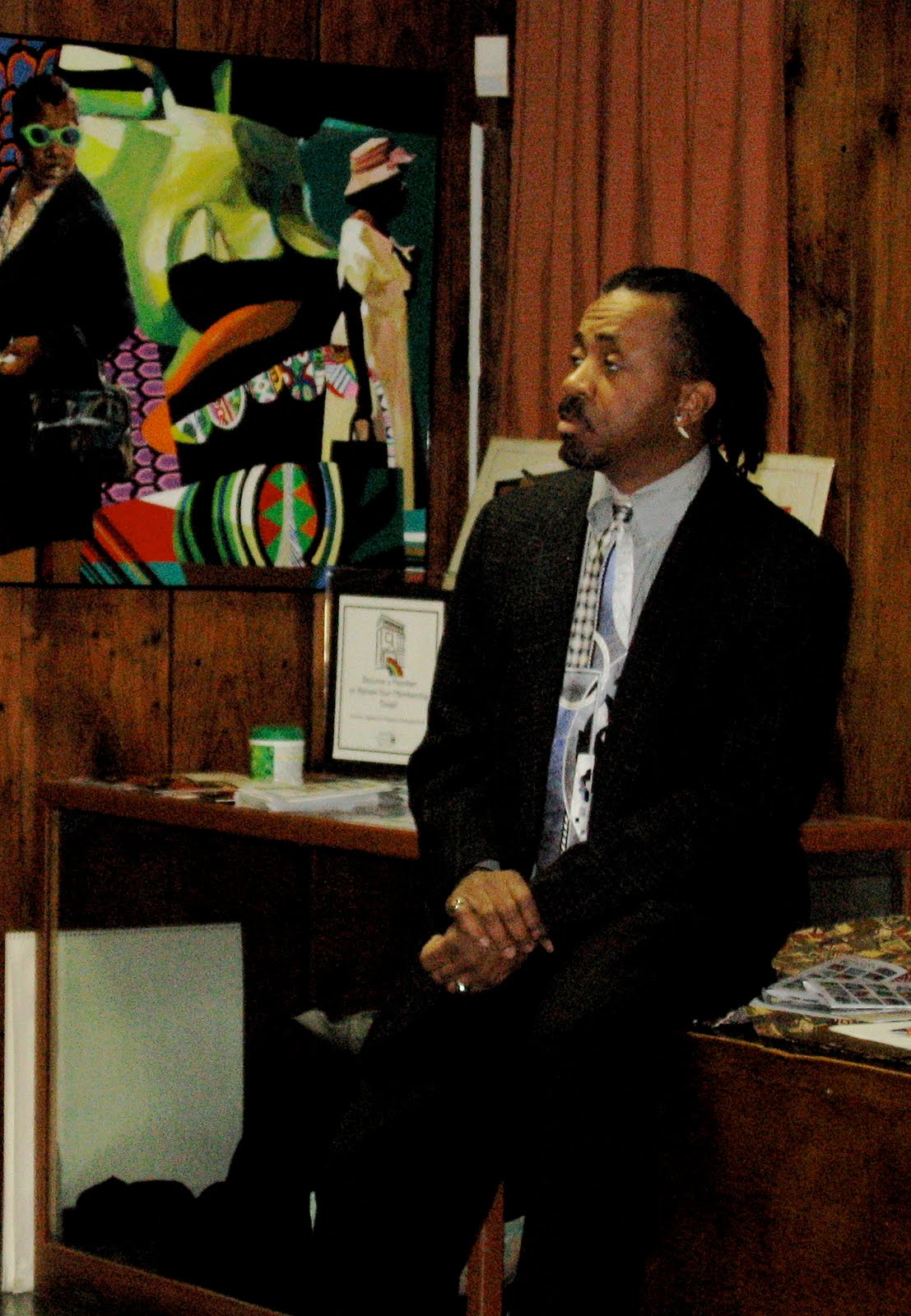
Artist, Publisher, Onli at the South
Side Community Art Center at
the Black Age of Comics Convention in Bronzeville.
the Black Age of Comics Convention in Bronzeville.
Onli was at the genesis of the Black Artist Movement in Chicago... He showcased the work
of BAG (many who also were studying art at
the Art Institute) in the Rhythmistic
esthetic.
The guild included such artists as the late illustrator and dancer, Kenneth Hunter, wood work artist, Esphi Eph, in textiles, Jim Smoote, painter, Dalton Brown and more.
The guild included such artists as the late illustrator and dancer, Kenneth Hunter, wood work artist, Esphi Eph, in textiles, Jim Smoote, painter, Dalton Brown and more.

Artist, Onli at Onli
Studios in Hyde Park Chicago.
As a innovative, creative ,exhibiting artist, Onli went on to develop his own Futuristic flow of Rhythmism into many mediums including illustrations, paintings, airbrush and wearable art... called Onliwear, which has flowed on several runways including the Limelight.
As a publisher...
ONLI Studios has published a variety of cutting edge publications, including art 'zines, graphic novels and books.
Some of the 'zines included PAPERS, and always one step ahead into the future , in the early eighties an art and entertainmenment zine called FUTURE FUNK.
As an independent Publisher, Onli created the movement which he defined and named..and has been called the
"Father of The Black Age of Comics".
Under the umbrella of the Black Age , Onli began to promote a national collective of artists who create independent creativity in their comic characters.
In his own collection, Onli developed Superheroes and heroines such as Sustah Girl, NOG, Protector of the Pyramids and Malcolm 10.

NOG Protector of the
Pyramids
In Bronzeville, Onli made the South Side Community Art Center an early home to The Black Age of Comics Convention.
The first several Black Age
Conventions were held at the SSCAC and which continues today in the new
millenium to showcase national artists who exude independent creativity and a
high standard of art making.
Onli hosted his first and early conventions for the Black Age at Bronzeville's Southside Community Art Center in 1992.
Currently the 13th annual convention
will be held at Kenwood Academy and will feature Sisters In the Black Age in
October 2010.
Currently, Black Age Conventions are now held annually in Chicago, hosted by Onli Studios, in Atlanta, (Onyx Con),
in Detroit (The Motor City Black Age of Comics) and on the East Coast (E.C.B.A.C.-The East Coast Black Age of Comics).
in Detroit (The Motor City Black Age of Comics) and on the East Coast (E.C.B.A.C.-The East Coast Black Age of Comics).
Many other Black Age Conventions have developed all over the country. See: https://www.blackageofcomics.com/
In the eighties, Turtel was the
director of Black on
Black Love Art Center (created by Soft' Sheen's Ed Gardner) which sat smack dab in the middle Robert
Taylor Homes.
He worked with students to develop their creativity in the midst of pretty perilous conditions.
Today Professor Onli teaches art at Harold Washington College.
He worked with students to develop their creativity in the midst of pretty perilous conditions.
Today Professor Onli teaches art at Harold Washington College.
AFRICOBRA

AFRICOBRA
(African Commune of Bad Relevant Artists)
Another important part of the Black Artist movement in Chicago was
started in Bronzeville right at the site of the (African Commune of Bad Relevant Artists)
Wall of Respect on 43rd and Langley during the late sixties.
For more information on AFRICOBRA see Onli's site:
"It was formed to provide a visual component to the
Black cultural revolution of that era. It started in Chicago and relocated its
base to Howard University in Washington DC when its founder became the
chairperson of Howard's Art Department. Many of its members were college
professors in the visual arts." - Professor Onli

"AFRICOBRA artists included Napoleon Henderson,
Wadsworth and Jay Jarrell, Michael Harris, Nelson Stevens, Ron Anderson, Jeff
Donaldson, Frank Smith, Barbara Jones-Hogu, Carol Lawrence, Murray DePillars,
Omar Lama, and Sherman Beck were key members of Africobra.
Ameer Nour, Lester Lashley, and Robert E. Paige along with Bill Walker were important artists who made considerable contributions to the development of this innovative movement in art." - Art Professor Onli
Ameer Nour, Lester Lashley, and Robert E. Paige along with Bill Walker were important artists who made considerable contributions to the development of this innovative movement in art." - Art Professor Onli
Africobra exhibited in Chicago at
Northwestern University in February 2010.
To see more about the artists and the
exhibit click on: AFRICOBRA
Bronzeville's visual art scene was very vibrant
with BAG,
Afri-Cobra, the South Side Community Art Center and the DuSable Museum of African-American History's Museum at Dr. Margaret Burroughs's home served as a artistic corridor on 38th and Michigan.
Afri-Cobra, the South Side Community Art Center and the DuSable Museum of African-American History's Museum at Dr. Margaret Burroughs's home served as a artistic corridor on 38th and Michigan.
And all the art fairs! In the summers
in Chicago... there was so many art fairs!
You knew the summer would stretch from June to August with the 57th St. Art Fair in Hyde Park, then the Lake Meadows Art Fair on 35th St and King Drive, in Bronzeville.
The Harper Court art fair had an annual fair with drummers and dancers and performances on 53rd and Harper. Harper Court at that time was filled with arts shops and stores like Window to Africa... where you could buy all the Afro-centric gear from clothes to statues, incense and the like.
The owner, Patrick Woofolk went on to create
the African Festival that is still a major festival on Chicago cultural scene.
Back in the day, it was a scene at
Harper Court. The outdoor Court was filled with brothers playing chess on the
stone tables and families would come to sit, eat and enjoy the flow of
conversations.
I remember playing with guitarist,
Dale Williams. Dale (who lives and works in LA these days) was a major crazoid
who loved everything from funk to R&B to rock to blues ...avante garde and
anything in-between. Cra-zaaaay Dale.
He was quick witted and had a quick finger on his fret board. Dale was great friends with upright bassist,the late BoBo (Oscar Brown Jr the III) and in the 70's they were young musicians in Hyde Park learning to jam. Dale went on play with Sun Ra and was forever cosmic from that day forward....

He was quick witted and had a quick finger on his fret board. Dale was great friends with upright bassist,the late BoBo (Oscar Brown Jr the III) and in the 70's they were young musicians in Hyde Park learning to jam. Dale went on play with Sun Ra and was forever cosmic from that day forward....

Guitarist, Dale Williams plays in Sun Ra Arkestra.
I flash back to the days that they
would float thru Hyde Park wearing huge wooden rings of color around their
necks and they both were loaded down with pan-pipes for sale.
Bobo and I wound up traveling to Ghana with another friend of ours, JNali, a creative , mystical spirit who passed from Malaria ten days after we returned to the US.
Bobo and I wound up traveling to Ghana with another friend of ours, JNali, a creative , mystical spirit who passed from Malaria ten days after we returned to the US.

BoBo(Oscar Brown Jr III)
waits for our flight to Ghana, West Africa 1973.

Aki waits for the flight
to Ghana, West Africa. 1973

Bobo and JNali waiting to
board our plane to Ghana, West Africa. August 1973
In the early seventies....Hyde Park
had musicians... for days....I had met BoBo, Maggie Africa and Napoleon Brown
and their dad ,Oscar Brown Jr. right in the neighborhood.
Dale and I would jam sometimes at my house.
Eventually, we all played for (BoBo' father) Oscar Brown Jr's play about Jean Pointe DuSable and urban youth in Chicago called "The Great Nitty Gritty".
Eventually, we all played for (BoBo' father) Oscar Brown Jr's play about Jean Pointe DuSable and urban youth in Chicago called "The Great Nitty Gritty".
One night Dale and I hung out with
guitarist, Lefty Dizz at the original Checkerboard Blues
Club around the corner from my house and we wound up playing all evening.. What
a groove...
Bobo and I played many trio gig with my group Akiboards and
oh... we had such a laid back float. A joy.. I will always miss Bo.
Later while interacting on the Pan-African creative 'set' in Chicago, I met drummer the late, Oye Bisi , log drum maker, Musu, Nii Clotte from Ghana and Baba Atiba of The Sun Drummers. The Sun Drummers would come to my house in Bronzeville to play for an African dance troupe that I had joined.
Our troupe was determined to dance
our way (raising funds) to Africa. And we did. Some of us made it to Ghana in
'73.
Oye Bisi was also a part of the Pharaohs but I only learned @ 2 decades later when I played with the group. Oye! a fiery drummer with a serious fighting spirit! Yes. Oye, we will remember his fire in his playing and in his sprit!

Percussionist, drummer Famadou Don Moye and
conga drummer, the late, Oye Bisi geting down with the spirits!
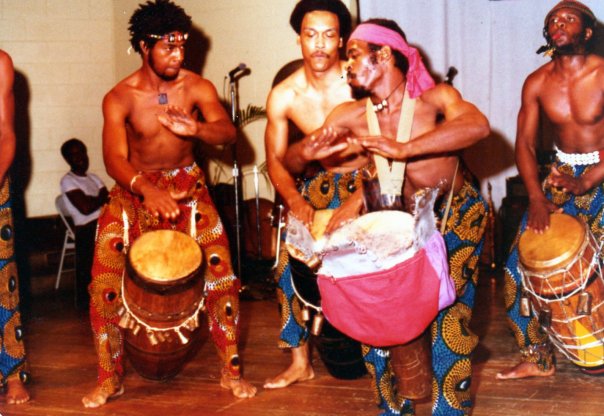
Baba Atiba (c)plays with other drummers in performance.
Speaking of the Sun Drummers, you have to
cite
Baba Atiba... as one of our Master drummers... who is the heartbeat of the Sun Drummers and central to the MUNTU drum's heartbeat as well.
Baba Atiba... as one of our Master drummers... who is the heartbeat of the Sun Drummers and central to the MUNTU drum's heartbeat as well.

Those were the days of huge
naturals..... I spent hours cornrowing hair..... and at Art fairs, African
Liberation Day Festivals.....and Learning Egyptian Hieroglyphics and Swahili.


Nefraton-Mottesila
at
African Liberation Day
1973 (ALD) Chicago.
The smell of incense was everywhere! Conga drummers were drumming at the Point (55th and the Lake) with African Dance
troupes and in the beginnings I was truly a novice then...

Jewelry maker, Kubvu at a
Chicago Art fair circa 1973.
Space is the Place!!! Kubvu introduced me to the music of
Sun Ra and to Ebah (Akh
Tal Ebah)(who was his
cousin) and a trumpet player in Sun Ra's Arkestra. Ebah spent many days exchanging
chord voicings and musical concepts on the piano with me..


When I played with the Niambi Big
Band at Phil Cohran's Transition East for a year, 1975-76 I played with
saxophonists, Steve
Coleman, Dwayne Armstrong, Al Smith, Ben Yamin, Jerry Wilson, Glen Burris, and trumpeter Paul Howard.
I also played in other settings with with Rahm Lee Michael Davis and Michael Harris, who both became
I also played in other settings with with Rahm Lee Michael Davis and Michael Harris, who both became
a part of EWF's Phenix Horns.

Rahm Lee Micheal Davis
plays in Chicago prior to joining the Phenix horns.
Musical arranger, Tom Tom 84 was on the scene at Paul Serrannos studio and we met many ,many years ago. Tom arranged for many performers including the Phenix Horns , Earth Wind and Fire and Phil Collins.
I appreciated the musical and art
scene of Chicago's
Pan - African set as I watched the music grow into the global rhythms that we hear and see today in works of Chicago 's musicians , artists and dancers like the Muntu, AACM, Sun Ra, Earth Wind & Fire.
Pan - African set as I watched the music grow into the global rhythms that we hear and see today in works of Chicago 's musicians , artists and dancers like the Muntu, AACM, Sun Ra, Earth Wind & Fire.
Pharaoh Sanders, John Coltrane,
Rashann Roland Kirk, Eddie Harris wafted out of loft parties in Hyde Park and South Shore...but I
was listening to the
Pharaohs.....
It was all about the horns... The
horns were killing! The ensemble parts were so tight and so electrifying..
It
was just be exciting just to hear the hits and articulation of Louis Satterfield (trombone), Don Myrick(alto sax),
Big Willie Woods(Trombone), Sir Charles Handy(trumpet), Aaron Dodd(tuba) Black Herman Waterford (Alto Sax), and
Rahm Lee Micheal Davis(trumpet).
Big Willie Woods(Trombone), Sir Charles Handy(trumpet), Aaron Dodd(tuba) Black Herman Waterford (Alto Sax), and
Rahm Lee Micheal Davis(trumpet).
And the rhythm section, please!...
African congas and a tight rhythm session that in the beginning included Yehuda
on guitar, drummer, Maurice White (who went on to form Earth Wind and Fire).
Fast forward to 1997.... I was walking past a room right after taking an education class at Harold Washington College. My mind was on certification and finishing a long series of classes in my field.
Then I heard that sound... It was
Damballa! I knew the horn hits...What was Damballa doing being played live here?! I was disconcerted!!
I hadn't heard that song for several decades!!
I hadn't heard that song for several decades!!
What was going on? So as a curious
musician, I stopped in.... I went on to see some of the original members of the Pharaohs rehearsing
for concerts... but they had no keyboardist at that moment. Hmmmmm.
I had never seen a female play with
them and the music was bit daunting...but it was etched in my memory just like
a James Brown riff... and they had charts so I said... I can do this! Sir
Charles Handy liked my flow and so we were on!!
How would one know how to articulate an intricate horn line like in Damballa just out of the blue....?
It's had to be in the memory.... an Ancient memory of a Pharaoh or a Queen... I had that memory ... waiting to dance....out of my sprit and onto my keys......
So for brief momento.... I became a
Pharaoh....
I was and I am Aki Antonia a.k.a. Queen Hatshepsut.
I was and I am Aki Antonia a.k.a. Queen Hatshepsut.
Riding the Nile on my keyboards.
Melodies and modes opened the secret passageways and the rhythms carried us
into the waves of Africano funk and flavor.
The Pharaohs ride again........
Pharaohs
By Neil Tesser
PHARAOHS
The Pharaohs' only studio album, Awakening, contains a song called "Freedom Road," and I've had its main hook darting through my head on a semi regular basis ever since I first heard it. What makes this remarkable is that I first heard it 25 years ago. Apparently it stuck in the ears of others as well: the original LP's cult popularity a generation later has led to its recent reissue, as well as the release of a live set called In the Basement (both on Luv n' Haight)--and now the wholly unexpected reactivation of this groove-hopping nonet. From the beginning, their tightly clustered horn harmonies and killer riffs made the Pharaohs somewhat analogous to Tower of Power--but though lesser known, they had a greater capacity for improvisation, far more rhythmic complexity, and an obviously different worldview (as seen in such song titles as "Damballa" and "Black Enuff"). In retrospect, it shouldn't surprise anyone that several members of the band ended up in Earth, Wind and Fire: both groups drew on different branches of the African-American river that courses through Chicago music history, linking such supposedly disparate entities as Muddy Waters, Eddie Harris, Sun Ra, and even disco champs the Ohio Players. By the time they disbanded in 1973 the Pharaohs had created an unforgettably vibrant, accessibly idiosyncratic fusion of soul, jazz, and African percussion. They had also tapped into the Egyptology-as-black-history movement popularized in music by Sun Ra, which provided the inspiration for the band's name; since then, founder and trumpeter Charles Handy has delved deeper into it through studies at the Field Museum. How this will play out in the band's second incarnation remains unknown, as does the chemistry between the remaining original Pharaohs--saxist Black Herman Waterford, trombonist Big Willie Woods, and guitarist Yehudah Ben Israel--and such new additions as tenor man Hank Ford and keyboardist Aki Antonia. In any case, this weekend the band I never thought I'd hear live plays for only the second time since the mid-70s. Friday, 9 and 11 PM, Velvet Lounge, 2128fi S. Indiana; 312-791-9050. NEIL TESSER
Art accompanying story in printed newspaper (not available in this archive): photo by Marc PoKempner.
The Pharaohs' only studio album, Awakening, contains a song called "Freedom Road," and I've had its main hook darting through my head on a semi regular basis ever since I first heard it. What makes this remarkable is that I first heard it 25 years ago. Apparently it stuck in the ears of others as well: the original LP's cult popularity a generation later has led to its recent reissue, as well as the release of a live set called In the Basement (both on Luv n' Haight)--and now the wholly unexpected reactivation of this groove-hopping nonet. From the beginning, their tightly clustered horn harmonies and killer riffs made the Pharaohs somewhat analogous to Tower of Power--but though lesser known, they had a greater capacity for improvisation, far more rhythmic complexity, and an obviously different worldview (as seen in such song titles as "Damballa" and "Black Enuff"). In retrospect, it shouldn't surprise anyone that several members of the band ended up in Earth, Wind and Fire: both groups drew on different branches of the African-American river that courses through Chicago music history, linking such supposedly disparate entities as Muddy Waters, Eddie Harris, Sun Ra, and even disco champs the Ohio Players. By the time they disbanded in 1973 the Pharaohs had created an unforgettably vibrant, accessibly idiosyncratic fusion of soul, jazz, and African percussion. They had also tapped into the Egyptology-as-black-history movement popularized in music by Sun Ra, which provided the inspiration for the band's name; since then, founder and trumpeter Charles Handy has delved deeper into it through studies at the Field Museum. How this will play out in the band's second incarnation remains unknown, as does the chemistry between the remaining original Pharaohs--saxist Black Herman Waterford, trombonist Big Willie Woods, and guitarist Yehudah Ben Israel--and such new additions as tenor man Hank Ford and keyboardist Aki Antonia. In any case, this weekend the band I never thought I'd hear live plays for only the second time since the mid-70s. Friday, 9 and 11 PM, Velvet Lounge, 2128fi S. Indiana; 312-791-9050. NEIL TESSER


